I am fascinated by the use of textiles and tapestries as a vehicle of telling stories throughout history. Spans cultures and time periods. Tapestries as stories, tapestries as practical pieces, tapestries as decoration, tapestries as modes to carry tradition.
I am not intending to culturally appropriate in any way at all with this research in relation to my project.
Rather, I am interested in how stories can be told within the parameters of a flat textile object, used not only to be visually pleasing, but to tell a story personal to that of the creator (and the community).

Mummering Costume - Yorkshire - 1829
"folk tradition involves people dressing up in flamboyant clothes, masking their faces and distorting their voices in order to conceal their identities."
"House visits are now the most common form of mummering. A group of mummers will call on friends and neighbours, where they get up to hijinks, play music, dance and act the fool. It is then the hosts’ job to guess the identity of each masked mummer. Once they have been correctly identified, they can remove their masks."

CHILKAT WEAVING
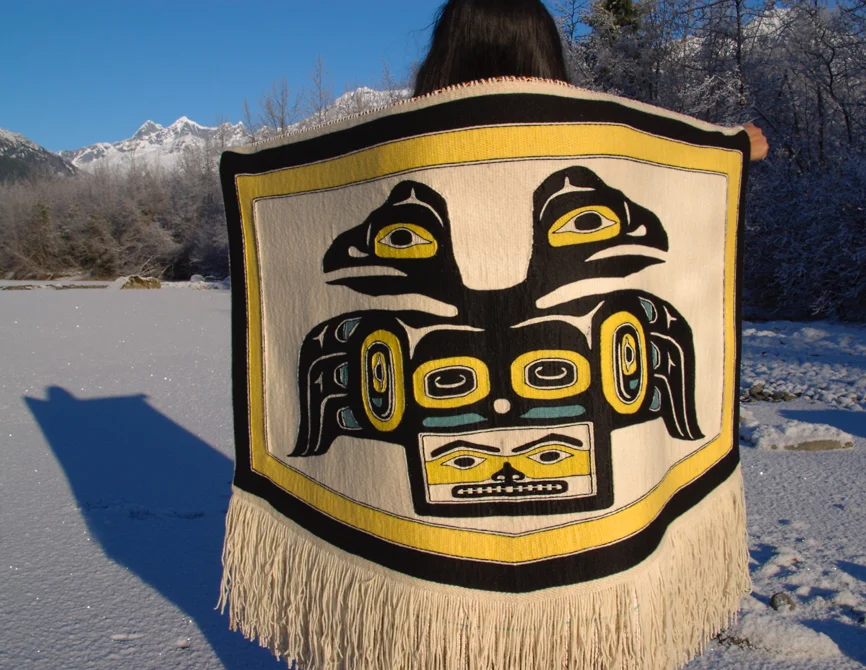

Anna Brown Ehlers
"Ehlers grew up watching her grandmothers—Mary Betts and Marie Peters—do beadwork and skin sewing, and she apprenticed under master weaver and 1986 NEA National Heritage Fellow Jennie Thlunaut, a close friend of her grandmother Mary."
"For the past 35 years, Ehlers has specialized in Chilkat weaving, an ancient art form indigenous to the Native people of Southeast Alaska. Throughout history, Chilkat blankets have been cherished as a sign of wealth, status, and social standing. Many ancient and modern Chilkat weavings depict the stories and histories of clans, and some are considered clan at.óowu—sacred objects that are imbued with ancestors’ spirits. Chilkat blankets are danced at secular events today and Chilkat at.óowu are brought out at ceremonies to invoke the spirits of the ancestors. While a number of her blankets are sold to museums and collectors, Ehlers prefers for her blankets to be used and danced in Tlingit ceremonies, and she often works out arrangements with clan members to purchase her blankets."
"Chilkat weaving is one of the most complex weaving styles in the world. For her materials, Ehlers collects goat hides from hunters, then washes, dries, and fluffs the downy wool. Cedar bark is collected in the spring and processed into paper-thin layers. She makes the warp by spinning together two strips of wool and two strips of cedar bark on her thigh. The warp is suspended from a simple crossbeam loom, at which time the finger weaving can begin. The preparation of the warp alone takes about four months for one full-size blanket.
One of the most significant challenges in Chilkat weaving is the use of curved shapes found in Northwest Coast formline design, which are very complex and difficult to execute. One full-size blanket can take a year or longer to complete."
-https://www.arts.gov/honors/heritage/fellows/anna-brown-ehlers


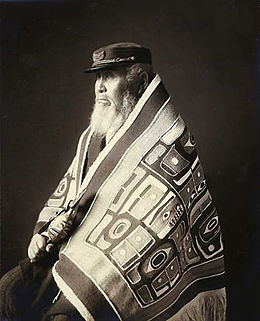
Jennie Thlunaut
"When still a little girl, she received her first box of mountain goat hair — one of the essential components of Chilkat weaving. Southeastern Alaska is rich in the natural resources needed for these weavings; in Chilkat blankets, mountain goat hair and the fibers from red cedar are woven together. When Thlunaut was 10 years old, her mother began to teach her to weave.
The Chilkat blanket has mythical origins, and the art of blanket weaving was transmitted from the Tsimshian to the Tlingit Chilkat in the nineteenth century. The designs woven into the blankets — stylized animal figures similar to those found in Tlingit carving — are the crests of family or clan groups and serve as property makers and emblems.
Chilkat blankets are worn in potlatches and other ceremonies, and their long-fringed borders create a spectacular display as the dancers spin and swirl. They are made for movement.
Over the course of her life, Thlunaut became a master weaver and is credited with single-handedly keeping the tradition alive in Alaska during a period of decline in interest in native crafts. She was directly or indirectly a great inspiration for younger weavers, who, in time, have renewed the vitality of the indigenous Tlingit traditions. By the end of her life, Thlunaut's blankets were selling on the open market for $10,000-$16,000 each, but despite this success she continued to give them away in the traditional manner. She never kept a single blanket for herself. "I don't want to be stingy with this," she said. "I am giving it to you, and you will carry it on."
-https://www.arts.gov/honors/heritage/fellows/jennie-thlunaut


Lakai Embroideries
"The Lakai Uzbeks moved from Central Asia in the north and settled in the Kunduz area of northern Afghanistan, after the Bolshevik revolution in Russia. They are particularly known for their embroidery. Their work is characterised by the use of the cross stitch, and the multi-coloured geometric motifs carried out on bags, belts and bands.
Many of the Lakai embroidered textiles, as for instance the door hangings, were used to ornament the interiors of their yurts"
- https://trc-leiden.nl/trc-needles/regional-traditions/iranian-plateau/lakai-uzbeks-afghanistan
"All Uzbek peoples, urban, rural and nomadic, made embroidery. "


Lakai Embroideries - Uzbekistan 1900
Other visual research, no contextual information found other than description:

Chinese Rug , 1900

Egyptian Textile fragment - 4th-7th century, Byzantine period, wool and linen

"fragment of pilgrim’s scarf, 19th century, bengali" - Wood-block printing on native muslin; the ground is light yellow, with designs of foot-prints, leaf and flower patterns and geometrical patterns with writing in red. The design is probably older than the workmanship.
Inuit Textiles

Miriam Qiyuk untitled (summer camp scene), 1990 wool felt & embroidery floss on duffel, 45 x 53.25 in.
"Qiyuk was born into the traditional nomadic lifestyle before moving to Baker Lake in her early twenties. She began creating wall-hangings and carvings in the early 1960s. Her carvings often deal with the legend of Kiviuq and the bird-woman to whom he is married."
The daughter of prominent Inuit artist Jessie Oonark:
The daughter of prominent Inuit artist Jessie Oonark:

Jessie Oonark - Untitled, 1973, duffle, felt

Marion Tuu'luq (Baker Lake)
"Tuu'luq used embroidery thread, felt, and dense woollen fabrics. She was a part of a circle of northern fabric artists (including Jessie Oonark and Irene Avaalaaqiaq Tiktaalaaq) who helped establish the contemporary art form of large-scale, two-dimensional, embroidered textile works."
" She "drew upon vivid colors, symmetry, and anthropomorphic imagery, to create vibrant tapestries which depict stories, legends, and personal experiences."
Kate Clayton Donaldson


No comments:
Post a Comment